Thank you for Subscribing to Chemical Industry Review Weekly Brief

Hygenall has been recognized by Chemical Industry Review Magazine as the exclusive recipient of “Top Toxic Chemical Metal Service 2026,” based on our proprietary methodology, reflecting its position in the industry, and is also named among “Top Chemical Processing Companies,” reflecting its broader leadership. This profile has been developed by the Chemical Industry Review research and editorial team based on insights from an interview with Christopher Cambridge, Digital Operations Manager.

Hygenall
Advancing Decontamination beyond Conventional Cleaning

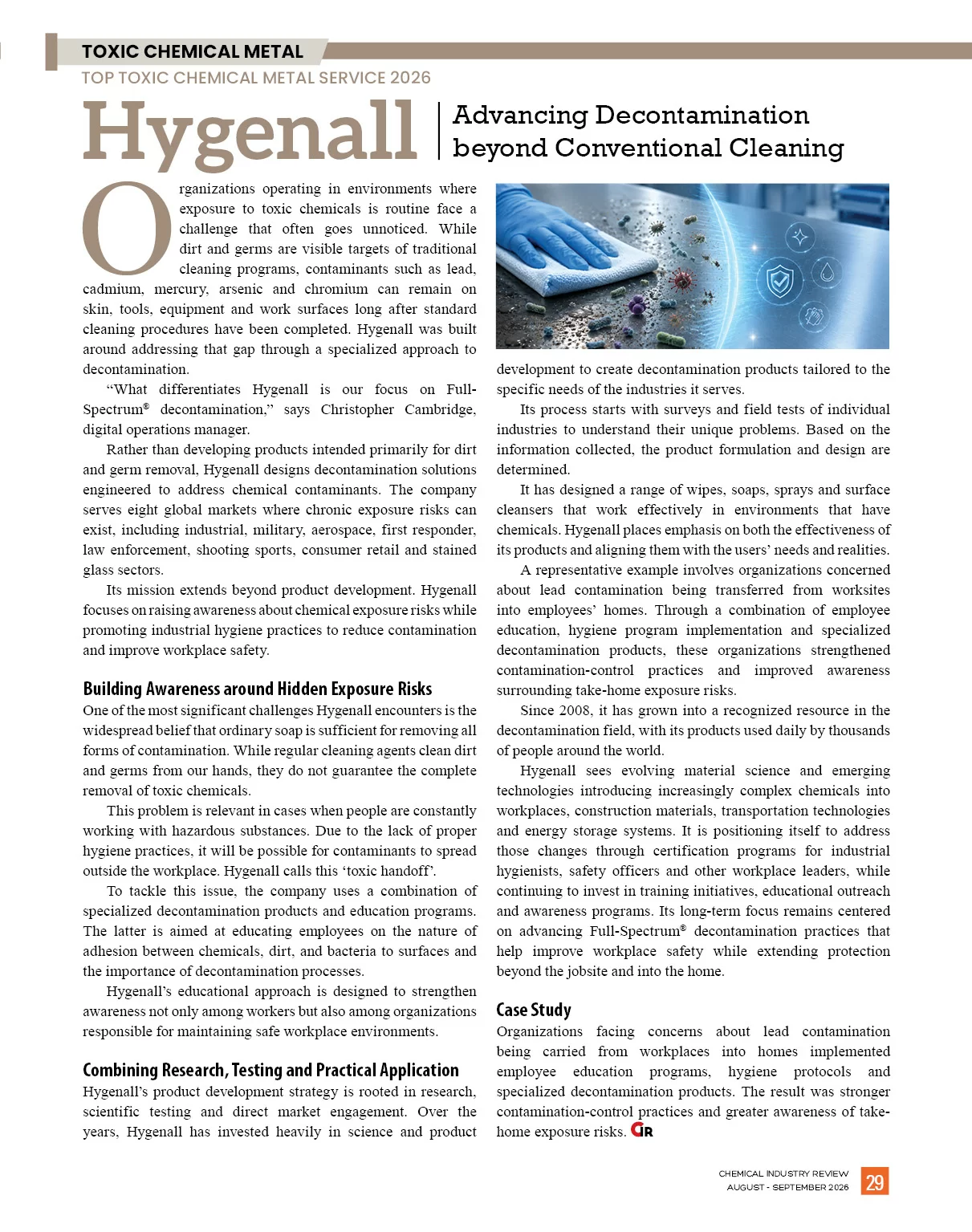
Organizations operating in environments where exposure to toxic chemicals is routine face a challenge that often goes unnoticed. While dirt and germs are visible targets of traditional cleaning programs, contaminants such as lead, cadmium, mercury, arsenic and chromium can remain on skin, tools, equipment and work surfaces long after standard cleaning procedures have been completed. Hygenall was built around addressing that gap through a specialized approach to decontamination.
“What differentiates Hygenall is our focus on Full-Spectrum® decontamination,” says Christopher Cambridge, digital operations manager.
Rather than developing products intended primarily for dirt and germ removal, Hygenall designs decontamination solutions engineered to address chemical contaminants. The company serves eight global markets where chronic exposure risks can exist, including industrial, military, aerospace, first responder, law enforcement, shooting sports, consumer retail and stained glass sectors.
Its mission extends beyond product development. Hygenall focuses on raising awareness about chemical exposure risks while promoting industrial hygiene practices to reduce contamination and improve workplace safety.
Building Awareness around Hidden Exposure Risks
One of the most significant challenges Hygenall encounters is the widespread belief that ordinary soap is sufficient for removing all forms of contamination. While regular cleaning agents clean dirt and germs from our hands, they do not guarantee the complete removal of toxic chemicals.
This problem is relevant in cases when people are constantly working with hazardous substances. Due to the lack of proper hygiene practices, it will be possible for contaminants to spread outside the workplace. Hygenall calls this ‘toxic handoff’.
To tackle this issue, the company uses a combination of specialized decontamination products and education programs. The latter is aimed at educating employees on the nature of adhesion between chemicals, dirt, and bacteria to surfaces and the importance of decontamination processes.
Hygenall’s educational approach is designed to strengthen awareness not only among workers but also among organizations responsible for maintaining safe workplace environments.
Combining Research, Testing and Practical Application
Hygenall’s product development strategy is rooted in research, scientific testing and direct market engagement. Over the years, Hygenall has invested heavily in science and product development to create decontamination products tailored to the specific needs of the industries it serves.
Its process starts with surveys and field tests of individual industries to understand their unique problems. Based on the information collected, the product formulation and design are determined.
It has designed a range of wipes, soaps, sprays and surface cleansers that work effectively in environments that have chemicals. Hygenall places emphasis on both the effectiveness of its products and aligning them with the users' needs and realities.
A representative example involves organizations concerned about lead contamination being transferred from worksites into employees’ homes. Through a combination of employee education, hygiene program implementation and specialized decontamination products, these organizations strengthened contamination-control practices and improved awareness surrounding take-home exposure risks.
Since 2008, it has grown into a recognized resource in the decontamination field, with its products used daily by thousands of people around the world.
Hygenall sees evolving material science and emerging technologies introducing increasingly complex chemicals into workplaces, construction materials, transportation technologies and energy storage systems. It is positioning itself to address those changes through certification programs for industrial hygienists, safety officers and other workplace leaders, while continuing to invest in training initiatives, educational outreach and awareness programs. Its long-term focus remains centered on advancing Full-Spectrum® decontamination practices that help improve workplace safety while extending protection beyond the jobsite and into the home.
Case Study
Organizations facing concerns about lead contamination being carried from workplaces into homes implemented employee education programs, hygiene protocols and specialized decontamination products. The result was stronger contamination-control practices and greater awareness of take-home exposure risks.
“What differentiates Hygenall is our focus on Full-Spectrum® decontamination,” says Christopher Cambridge, digital operations manager.
Rather than developing products intended primarily for dirt and germ removal, Hygenall designs decontamination solutions engineered to address chemical contaminants. The company serves eight global markets where chronic exposure risks can exist, including industrial, military, aerospace, first responder, law enforcement, shooting sports, consumer retail and stained glass sectors.
Its mission extends beyond product development. Hygenall focuses on raising awareness about chemical exposure risks while promoting industrial hygiene practices to reduce contamination and improve workplace safety.
Building Awareness around Hidden Exposure Risks
One of the most significant challenges Hygenall encounters is the widespread belief that ordinary soap is sufficient for removing all forms of contamination. While regular cleaning agents clean dirt and germs from our hands, they do not guarantee the complete removal of toxic chemicals.
This problem is relevant in cases when people are constantly working with hazardous substances. Due to the lack of proper hygiene practices, it will be possible for contaminants to spread outside the workplace. Hygenall calls this ‘toxic handoff’.
To tackle this issue, the company uses a combination of specialized decontamination products and education programs. The latter is aimed at educating employees on the nature of adhesion between chemicals, dirt, and bacteria to surfaces and the importance of decontamination processes.
Hygenall’s educational approach is designed to strengthen awareness not only among workers but also among organizations responsible for maintaining safe workplace environments.
Combining Research, Testing and Practical Application
Hygenall’s product development strategy is rooted in research, scientific testing and direct market engagement. Over the years, Hygenall has invested heavily in science and product development to create decontamination products tailored to the specific needs of the industries it serves.
-
What differentiates Hygenall is our focus on Full-Spectrum® decontamination.
Its process starts with surveys and field tests of individual industries to understand their unique problems. Based on the information collected, the product formulation and design are determined.
It has designed a range of wipes, soaps, sprays and surface cleansers that work effectively in environments that have chemicals. Hygenall places emphasis on both the effectiveness of its products and aligning them with the users' needs and realities.
A representative example involves organizations concerned about lead contamination being transferred from worksites into employees’ homes. Through a combination of employee education, hygiene program implementation and specialized decontamination products, these organizations strengthened contamination-control practices and improved awareness surrounding take-home exposure risks.
Since 2008, it has grown into a recognized resource in the decontamination field, with its products used daily by thousands of people around the world.
Hygenall sees evolving material science and emerging technologies introducing increasingly complex chemicals into workplaces, construction materials, transportation technologies and energy storage systems. It is positioning itself to address those changes through certification programs for industrial hygienists, safety officers and other workplace leaders, while continuing to invest in training initiatives, educational outreach and awareness programs. Its long-term focus remains centered on advancing Full-Spectrum® decontamination practices that help improve workplace safety while extending protection beyond the jobsite and into the home.
Case Study
Organizations facing concerns about lead contamination being carried from workplaces into homes implemented employee education programs, hygiene protocols and specialized decontamination products. The result was stronger contamination-control practices and greater awareness of take-home exposure risks.
Controlling Toxic Metal Transfer at its Source
Chemical residue rarely stays where the work occurs. Fine particles can remain on hands, clothing, tools and shared surfaces, and then move into vehicles or homes before anyone recognizes the transfer. Procurement teams therefore face a narrower question than general cleanliness. They must determine whether a decontamination program can interrupt repeated contact with toxic metals such as lead or cadmium at the points where exposure is most likely to continue.
Ordinary soap and multipurpose cleaners may support routine hygiene, but buyers cannot assume that products designed for dirt or germs will address chemical residue. Product selection should begin with documented contaminant scope and a clear explanation of how the formulation removes targeted metals from skin or nonporous surfaces. Safety data sheets, test methods, efficacy reports and use instructions deserve close review. Broad claims matter less than evidence tied to the substances present at a facility and the surfaces workers actually touch.
Placement also determines whether a product becomes part of daily practice. A technically capable cleaner has limited value when it is unavailable near a changing area, wash station, field vehicle or contaminated tool bench. Executives should examine dispenser formats, refill requirements, storage footprint and the time needed for correct use. Rinse-free options can suit field settings, while foaming washes may fit fixed facilities. Surface cleaners and laundry products may be needed where contamination reaches equipment or work clothing. The aim is not to purchase the largest assortment. It is to match each product format to a specific transfer point.
Employee behavior creates the harder purchasing test. Chemical hygiene programs often weaken when workers view decontamination as an occasional response rather than a routine control. Clear instructions must explain what should be cleaned, when the step belongs in the workflow, how contaminated items should be handled and where used materials should be placed. Training should also address take-home exposure without relying on alarmist language. Instructions need to survive shift changes and contractor turnover. Materials written only for specialists may not translate at handwashing stations or mobile response sites. A credible supplier helps safety personnel turn product use into a repeatable practice that supervisors can reinforce and audit.
Procurement review should extend beyond unit price. Buyers need to consider consumption rates, storage conditions, staff time and compatibility with existing wash areas or waste procedures. Refill systems may lower replacement burden, but only when staff can maintain them consistently. Product availability across hand cleaning and surface treatment can simplify purchasing, although standardization should never override contaminantspecific evidence. The strongest program is one that can be adopted without weakening the controls already in place.
Hygenall merits consideration for organizations addressing repeated exposure to toxic metals. Its Full-Spectrum approach is built around removing chemical contaminants alongside dirt and germs, rather than treating ordinary cleaning as sufficient. Its range includes LeadOff wipes and foaming washes, cleaners for nonporous surfaces and ToxOff laundry detergent for contaminated clothing. Hygenall also develops market-specific training and certification programs that support hygiene adoption. Its combination of specialized formulations and practical dispensing formats aligns well with buyers that need decontamination at fixed facilities and field locations. The fit is strongest where one program must cover skin, equipment, workwear and worker education.
...Read more
